
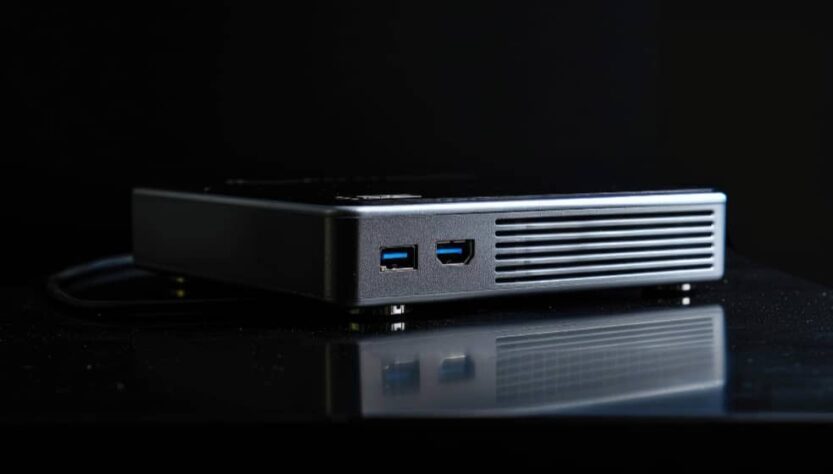
Learn how a mini PC works, which parts it uses, where it performs best, and what specs matter before buying. Read this complete beginner’s guide.
How Does a Mini PC Work? A Beginner’s Guide to Compact Computers
A mini PC works like a conventional desktop computer, processing software instructions through a CPU, storing active data in RAM, and loading files from an SSD. It delivers this functionality in a much smaller enclosure by using compact components, efficient processors, integrated graphics, and a cooling system designed for limited internal space.
Despite its size, a mini PC can run a complete operating system, connect to standard monitors and peripherals, access local networks, and handle many of the same applications as a traditional tower. The difference is not in the basic computing process, but in how tightly the hardware is packaged and how carefully power consumption and heat must be controlled.
Modern models range from inexpensive systems for browsing and office work to high-performance machines capable of software development, media production, local server tasks, and gaming. Read on to understand what happens inside a mini PC, where its practical limits lie, and which specifications deserve attention before you buy one.
Key takeaways:
- A mini PC processes data in the same fundamental way as a full-size desktop computer.
- Compact processors, integrated graphics, SSD storage, and efficient cooling allow the hardware to fit inside a small chassis.
- Most mini PCs are well suited to office work, streaming, programming, home servers, and light creative workloads.
- CPU class, RAM capacity, storage, connectivity, cooling, and upgradeability should be matched to the intended workload.
How Does Mini PC Work Inside Such a Small Chassis?
A mini PC works by executing the same fetch, decode, execute, and store cycle used by a conventional computer. The processor retrieves an instruction from memory, interprets it, performs the required operation, and writes the result back to memory or storage. This cycle happens billions of times per second while the operating system coordinates applications, hardware resources, and connected devices.
When you open a browser, for example, the operating system loads part of the application from the SSD into RAM. The CPU processes the program’s instructions, while the graphics processor renders the browser interface and website content. Network hardware exchanges data with the router, and the display controller sends the completed image to the monitor through HDMI, DisplayPort, or USB-C.
The main engineering difference is density. A traditional desktop spreads its components across a large motherboard and provides room for expansion cards, multiple storage drives, large heatsinks, and powerful fans. A mini PC uses a compact motherboard with many controllers integrated directly into the processor or soldered onto the board.
Most models receive electricity from an external power adapter similar to a laptop charger. Internal voltage regulators then distribute the correct voltage to the processor, memory, storage, wireless module, and connected USB devices. This arrangement reduces the amount of heat-generating power hardware that must fit inside the enclosure.
What Components Are Inside a Mini PC?
A mini PC contains the same essential computing components as a desktop tower, but they are smaller, more integrated, and arranged more densely. The exact configuration varies by model, especially between ready-to-use systems and barebones units.
- Processor: The CPU executes software instructions and controls most system operations, while many modern processors also contain the integrated graphics engine.
- Motherboard: A custom compact board connects the processor, memory, storage, networking hardware, ports, and power delivery circuitry.
- RAM: System memory temporarily stores data needed by active applications, browser tabs, virtual machines, and background services.
- Storage: Most current models use an M.2 NVMe SSD, although some also provide space for a 2.5-inch SATA SSD or hard drive.
- Graphics hardware: Integrated graphics share system memory, while selected performance-oriented mini PCs include a dedicated GPU.
- Cooling system: Heat pipes, heatsinks, fans, ventilation openings, or passive metal enclosures transfer heat away from the processor.
- Network interfaces: Ethernet, Wi-Fi, and Bluetooth provide wired and wireless connectivity.
- Input and output ports: USB, HDMI, DisplayPort, audio, Thunderbolt, or USB4 connections support displays and peripherals.
Many mini PCs use laptop-class processors because these chips are designed to deliver useful performance within strict power and temperature limits. However, compact computers are no longer restricted to low-power mobile hardware. Larger performance models may use higher-wattage laptop chips, socketed desktop processors, dedicated graphics, or newer processors with built-in neural processing units for local AI workloads.
Memory implementation also differs between products. Some systems have replaceable SO-DIMM modules, while thinner models may use soldered memory. Replaceable modules make later upgrades easier, but soldered memory can allow a smaller board and, in some architectures, higher memory bandwidth.
Why Do Cooling and Power Limits Affect Mini PC Performance?
Cooling and power limits determine how long a mini PC can maintain its highest performance. A processor may reach impressive speeds during a short task, but sustained rendering, code compilation, gaming, or video encoding produces heat that must be removed from a very small enclosure.
Modern processors automatically adjust their clock speeds according to workload, temperature, and available electrical power. During a brief operation, the CPU may boost well above its base frequency. If the cooling system cannot dissipate the resulting heat, the processor reduces its speed to remain within a safe temperature range. This behaviour is known as thermal throttling.
A compact computer with a well-designed heatsink and fan can outperform a thinner model using the same processor, particularly during workloads that last several minutes. For this reason, peak clock speed alone does not provide a complete picture of performance. Independent sustained-load testing is more useful when choosing a system for demanding work.
Mini PCs commonly use one of the following cooling designs:
- Active air cooling: A small fan pushes air through a heatsink and provides the best balance of size, performance, and cost for mainstream systems.
- Dual-fan or multi-zone cooling: Higher-performance models may cool the processor, memory, voltage regulators, and storage separately.
- Passive cooling: A fanless metal enclosure acts as a large heatsink, eliminating noise but restricting the amount of heat the system can handle.
- Vapour chamber or heat-pipe cooling: Thermal components spread heat across a larger surface before it is expelled from the chassis.
Fanless systems work particularly well for digital signage, light office applications, network appliances, and environments where silence or dust resistance matters. Active cooling is usually preferable for development tools, creative software, gaming, and sustained multitasking.
Read more on how to reduce mini pc fan noise.
How Does a Mini PC Compare With a Desktop Computer and a Laptop?
A mini PC sits between a desktop tower and a laptop, combining a desktop-style workspace with a compact and relatively portable enclosure. It saves more desk space than a tower and offers greater monitor flexibility than a laptop, but it normally provides fewer upgrades than a full-size desktop and lacks the laptop’s built-in screen and battery.
| Category | Mini PC | Desktop Tower | Laptop |
|---|---|---|---|
| Physical size | Very compact and often mountable behind a monitor | Requires the most floor or desk space | Compact as a complete mobile workstation |
| Built-in display and battery | No | No | Yes |
| Upgradeability | Usually limited to RAM, storage, and wireless modules | Best support for processors, graphics cards, drives, and expansion cards | Often limited, with many soldered components |
| Cooling capacity | Moderate and highly dependent on chassis design | Highest capacity for sustained workloads | Restricted by thin mobile construction |
| Multi-monitor support | Often strong, depending on available video outputs | Strong and expandable with graphics hardware | Varies by port selection and graphics design |
| Best fit | Compact fixed workstations, media centres, servers, and shared spaces | High-end gaming, rendering, expansion, and component upgrades | Frequent travel and work without an external display |
A mini PC is easy to move between locations, but it is not independently mobile. You still need a display, keyboard, mouse, and power source at the destination. This can work well for someone who uses equipped desks in two offices, but a laptop remains more convenient for trains, airports, classrooms, and temporary workspaces.
A tower is still the stronger choice when a workload requires a large dedicated graphics card, several internal drives, specialist PCIe cards, or regular component replacement. The mini PC becomes more attractive when low noise, lower power consumption, flexible monitor choice, and a clean desk matter more than maximum expansion.
What Can You Use a Mini PC For?
A mini PC can serve as a primary work computer, media centre, development machine, home server, digital signage controller, or secondary network device. Its suitability depends less on physical size than on the installed processor, memory, storage, graphics hardware, and cooling capacity.
- Office and remote work: Email, documents, spreadsheets, browser applications, video meetings, and multi-monitor workflows run comfortably on a properly configured system.
- Web browsing and cloud software: Cloud applications place much of the processing load on remote servers, so reliable networking and sufficient RAM often matter more than a premium CPU.
- Media centre: A compact PC can connect to a television for streaming, local video playback, music, photo libraries, or home theatre software.
- Programming and development: Mini PCs can run code editors, integrated development environments, local databases, containers, and lighter virtual machines.
- Home server: A low-power system can host files, backups, smart home services, development repositories, network tools, or a personal media server.
- Digital signage: Their small size allows them to sit behind commercial displays and run continuously without a visible tower.
- Education and shared computing: Schools, libraries, dorm rooms, and family workspaces benefit from compact hardware that is easy to replace or relocate.
- Local AI workloads: Higher-end systems with capable integrated graphics, dedicated GPUs, or neural processing units can run selected inference and automation tasks locally.
For standard office work, 16 GB of RAM and a responsive SSD usually make a greater practical difference than paying for the fastest available processor. Video calls, office software, and dozens of browser tabs compete for memory, so an 8 GB system can become restrictive even when its CPU is adequate.
Media-centre buyers should pay attention to supported display resolutions, refresh rates, audio formats, HDMI versions, fan noise, and network stability. A device hidden inside a closed cabinet may run hotter than the same machine placed in the open, so ventilation still matters during long playback sessions.
Can a Mini PC Handle Gaming and Creative Work?
A mini PC can handle gaming and creative software when its graphics performance, memory capacity, and cooling system match the workload. Integrated graphics are often sufficient for esports games, older releases, emulation, photo editing, graphic design, and basic 1080p video production.
More demanding games place much greater pressure on graphics performance and memory bandwidth. A modern integrated GPU may provide playable results at reduced resolution and quality settings, but ray tracing, high-refresh-rate gaming, and maximum-detail AAA titles generally require dedicated graphics.
Graphics options in compact computers include:
- Integrated graphics: The GPU is built into the processor and shares system memory, reducing size, heat, and cost.
- Dedicated mobile graphics: Selected gaming-oriented systems use a separate GPU similar to those found in performance laptops.
- Desktop-class dedicated graphics: Larger mini PCs may accommodate compact replaceable graphics cards, although these systems approach small-form-factor desktop dimensions.
- External graphics: Some USB4, Thunderbolt, or OCuLink-equipped models can connect to an external GPU enclosure.
An external GPU can significantly increase graphics performance, but it adds another enclosure, power supply, cable, and cost. It also consumes part of the available interface bandwidth, so performance may not equal the same graphics card installed directly in a desktop PCIe slot.
For creative work, short video projects, photo processing, web design, and social media production are realistic on many modern models. Long 4K timelines, complex effects, 3D rendering, and repeated high-resolution exports require more careful evaluation of sustained CPU and GPU performance.
Which Mini PC Specifications Matter Most?
The most important mini PC specifications are the processor class, RAM capacity, storage configuration, graphics capability, connectivity, and cooling design. These factors determine not only benchmark performance but also how responsive, quiet, and useful the computer remains during daily work.
| Specification | Why It Matters | Practical Starting Point |
|---|---|---|
| Processor | Controls application speed, multitasking, code compilation, and media processing | A current-generation mid-range CPU for general use |
| RAM | Determines how many applications, tabs, services, or virtual environments can remain active | 16 GB for most users and 32 GB for heavier multitasking |
| Storage | Affects boot time, application loading, file transfers, and local capacity | A 512 GB NVMe SSD or larger |
| Graphics | Influences gaming, 3D applications, video effects, and display support | Integrated graphics for general use and dedicated graphics for demanding workloads |
| Display outputs | Determine the number, resolution, and refresh rate of connected monitors | At least two suitable outputs for a multi-monitor workstation |
| Networking | Affects cloud applications, video calls, file transfers, and server use | Gigabit Ethernet or faster, plus Wi-Fi 6 or newer |
| Cooling | Controls sustained performance, surface temperature, and fan noise | A reviewed cooling design appropriate for the processor’s power class |
Processor generation can matter more than the marketing tier printed on the box. A newer mid-range chip may outperform an older premium processor while using less electricity and producing less heat. Compare architecture, core count, power configuration, and sustained benchmark results rather than relying only on a product family name.
For memory, 8 GB remains usable for light browsing and simple office tasks, but 16 GB is a more practical baseline for a new system. Developers, creators, virtual-machine users, and people working with large datasets may benefit from 32 GB or more.
Storage capacity should reflect how much data will remain local:
- 256 GB: Suitable for a basic cloud-focused system with few installed applications.
- 512 GB: A balanced starting point for office software, development tools, and personal files.
- 1 TB: Better for games, media libraries, project files, virtual machines, and long-term use.
- 2 TB or more: Useful for local video production, large software environments, or server storage.
Ports can become a hidden limitation. Check the exact capabilities of each USB-C connector because identical-looking ports may support different features. One may provide data transfer only, while another supports USB4, display output, charging, or external graphics.
A practical connectivity checklist includes:
- Enough USB-A ports for existing peripherals and external drives.
- USB-C, USB4, Thunderbolt, or OCuLink when high-speed expansion is required.
- HDMI or DisplayPort outputs compatible with the intended resolution and refresh rate.
- Ethernet suitable for the local network, including 2.5 Gigabit Ethernet when large file transfers matter.
- Wi-Fi 6, Wi-Fi 6E, or a newer standard for reliable wireless access.
- Bluetooth support for headphones, keyboards, mice, controllers, and speakers.
In my experience as a developer, additional RAM and a fast SSD usually improve daily responsiveness more noticeably than a small increase in peak processor frequency. This is especially true when a workflow includes containers, local databases, browser-based documentation, communication apps, and an integrated development environment running at the same time.
Can You Upgrade a Mini PC?
Many mini PCs allow RAM, storage, and wireless upgrades, but the processor and graphics hardware are usually fixed. Upgrade options depend on the enclosure, motherboard layout, component type, and whether the manufacturer provides access to internal slots.
A fully configured mini PC normally includes memory, storage, wireless connectivity, and an operating system. A barebones model may include only the chassis, motherboard, processor, and cooling system, requiring the buyer to install compatible RAM, storage, and sometimes a wireless module.
Before buying a barebones system or planning an upgrade, verify:
- The supported RAM generation and form factor.
- The maximum memory capacity and number of available slots.
- The supported M.2 SSD lengths, interfaces, and PCIe generations.
- Whether the system accepts an additional SATA drive.
- The wireless module format and antenna connections.
- Whether opening the enclosure affects warranty coverage.
Upgradeable memory and storage can extend the useful life of a compact computer. A system purchased with 16 GB of RAM and a 512 GB SSD may later be expanded for virtual machines, larger projects, or a growing media library without replacing the entire device.
Some ultra-compact models solder RAM and storage directly to the motherboard. These systems can be thinner and simpler, but the original configuration becomes permanent. In that situation, buying enough capacity at the start is more important.
Operating system support deserves the same attention as hardware. Windows 11 is common and offers broad compatibility with business applications and peripherals. Linux can be a strong choice for programming, network services, privacy-focused environments, and lightweight server roles, but buyers should confirm support for the system’s Wi-Fi, audio, graphics, and power-management hardware.
How Should a First-Time User Set Up a Mini PC?
A first-time user should connect the essential peripherals, install system updates, verify drivers, configure displays, and confirm that the ventilation openings remain unobstructed. Completing these steps before installing a full software environment reduces the chance of troubleshooting several unrelated issues later.
- Connect the display: Use HDMI, DisplayPort, or USB-C and confirm that the cable supports the required resolution and refresh rate.
- Add input devices: Connect a wired keyboard and mouse initially, particularly if Bluetooth pairing is not yet configured.
- Establish networking: Use Ethernet during setup when possible, or connect to a secured Wi-Fi network.
- Install updates: Apply operating system, security, firmware, graphics, chipset, and network updates.
- Check display settings: Confirm scaling, resolution, refresh rate, colour profile, and multi-monitor arrangement.
- Review storage: Check available capacity and initialise any additional installed drive.
- Test temperatures and noise: Run the usual applications and confirm that the system remains stable without excessive fan noise.
- Organise airflow: Leave space around vents and avoid placing the computer under papers, inside a sealed cabinet, or directly against a wall.
Mini PCs do not require special monitors, keyboards, mice, storage devices, or USB receivers. Standard peripherals work as long as the computer provides compatible ports. Adapters and docking stations can expand connectivity, but selecting a model with the correct native ports usually creates a cleaner and more reliable setup.
A VESA-compatible mount can hide the computer behind a monitor, although the mounting position should not block airflow or make frequently used ports inaccessible. In media-centre installations, an infrared receiver, wireless keyboard, or compact remote can provide more convenient control from a sofa.

